“She’s psycho.”
“He’s acting like a sociopath.”
“You’re literally insane.”
“What a spaz.”
“Retard.”
“I’m gonna shoot myself, I did so bad on this project.”
“They are just crazy.”
These labels and phrases are casually thrown about daily. Just walking through the halls of any institution—perhaps Glenbrook North High School but additionally a workplace, community center, sports arena, almost anywhere people are gathered—I could guarantee one would hear an abundance of these labels strewn lightly about like flower petals.
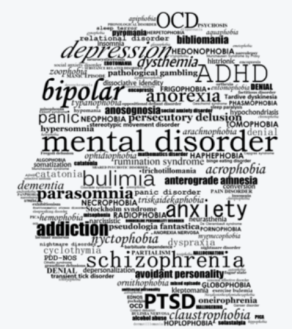
Examples of various mental illness labels. Photo courtesy of Psychology Today.
But in these cases, the flowers aren’t a symbol of celebration, demonstrating acceptance and love. In fact, casually, carelessly throwing around these words adds to the growing stigma around mental health, the stigma built by our very own cycle of socialization. Whether these label perpetrators are talking about someone with a mental illness or someone without one is unimportant to the fact that derogatory labels are hazardous regardless. They have the ability to devalue the mental illnesses people actually do live with, as well as act as a blockade from achieving empathy with others. Labeling is not an effective tool of organization in a society that needs far more integration. Although topics of race and religion are common in discussion of integration, this piece and our Gallery of Conscience booth work to shine a light on a whole different target group that gets far less attention: the mentally ill. And yes, that does include the chronically mentally ill, the ones that society has forced the mass population to turn a blind eye to as they are simultaneously blinded from reality by being placed in jail.
In his book, Crazy: A Father’s Search Through Mental Health Madness, Pete Earley discusses how the cycle of socialization is responsible for creating, maintaining, and further feeding the stigma around mental illness. Through memoric reflection about his bipolar son as well as extensive research on and first-hand experience visiting jails full to the brim with untreated mentally ill patients, Earley does not hold back. Even the title of his book is a nudge at the stigma itself.
In proper MLA citation: “They are just crazy” (Too many people to count, everyday).
Earley highlights this stigma while reflecting on his visit to Passageway, a treatment center that aids mentally ill felons in their transition back to independent living. Carl, a middle age man with schizophrenia who lives at Passageway, explains, “‘They [people in society] don’t feel sorry for someone who is schizophrenic. You know what I hate? I hate it whenever I hear someone say they are acting ‘schizo.’ What they mean is they are acting like they got two different personalities. Being schizophrenic ain’t anything like that’” (Earley 334). Carl’s vulnerability confesses that these labels being applied like sticky notes instead of tattoos has a genuine, negative impact on the mental health of the mentally ill. As if they weren’t already reminded of their illness daily by hallucinations in their head and irrational, uncontrollable thoughts and desires, they receive additional notions from strangers in society.
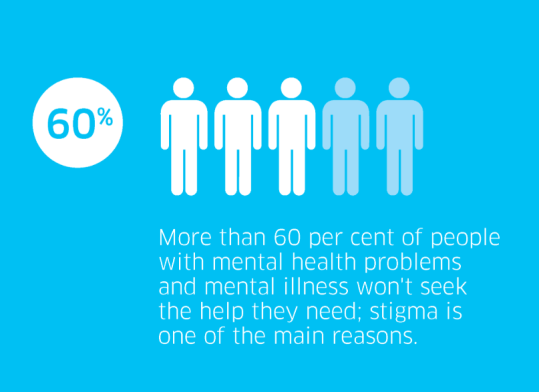
The effect that stigmas and social judgment have on the treatment habits of the mentally ill. Graphic courtesy of Mental Health Commission.
Because of our own self-serving biases and egocentric tendencies, it is easy for us to criticize people who outwardly shun mentally ill, or the police officers who lock them up, as we claim “I would never do something like that”. However, in reality, we are feeding the stigmas that created the mass incarceration of the mentally ill just by being a non-active citizen. Bobbie Harro explains this concept in her article, “The Cycle of Socialization” when she writes, “The cycle has a life of its own. It doesn’t need our active support because it has its own centrifugal force. It goes on, and unless we choose to interrupt it, it will continue to go on. Our silence is consent” (50). If one is not sincerely taking action toward bettering the lives of the mentally ill, they are only further developing the cloud surrounding the disorders. The idea of “taking action” has a reputation of completing an overbearing, intimidating task, like running your own protest or speaking to governors. Although those larger tasks do work toward achieving larger goals, “taking action” comes in many forms. By shutting down a classmate or coworker who uses stigmatizing words like “schizo” in a devaluative manner, one is taking their part in preventing the shame from further infecting society.
Not only is the “dominant” group in society—the non-mentally ill—blocked from education about those with disorders because of this cycle, but additionally the mentally ill themselves fall into the trap of learned helplessness. Harro highlights this concept and uses “our” to refer to those in “target” groups: “By participating in our roles as targets we reinforce stereotypes, collude in our own demise, and perpetuate the system of oppression. This learned helplessness is often called internalizing oppression because we have learned to become our own oppressors from within” (50). Due to this absorption of “fate”, when unprivileged people believe “they are doomed anyway”, they may embrace society’s expectations of them.
This is a common thread seen on life’s path for many of the mentally ill, as once they are released back on the streets after serving jail time, they often fall back into drug abuse or a lack of job maintenance. Earley shares, “The justice system is completely overwhelmed with mentally ill inmates, and few of them were getting any actual treatment [in jail]. Instead, they were being shuffled back and forth between the jail and the hospital, being made ‘competent’” (78). The mentally ill are robbed of a chance of improvement at any point in their perpetuating cycle as affordable, practical and proper treatment is not yet a guaranteed right. The classic debate of how much social security should be given to any disadvantaged group arises once again, although the mentally ill are hardly ever in the spotlight of the daily news. Once again, they are pushed away to the outer edges of our attention, isolated from the average citizen.
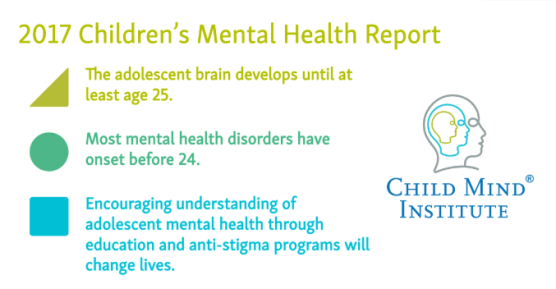
Child Mind Institute provides information on how education has the power to prevent further spreading of the mental illness stigma crisis.
The next step after taking action is achieving empathy. Because of Earley’s position as a mentally able man himself, he gives insight on the difficulty of his personal journey of finding this sense of understanding. He writes:
The federal government says mental illness is a chemical imbalance, and because of that it’s a sickness and not something, {…} that anyone seeks or wants or deserves to get {…}. But deep down, we really don’t want to believe that’s true. Because if we did, we would have to admit: It could happen to us. It could happen to me. I could become the sniveling, deranged creature hiding under the steel bunk nibbling on day-old orange peels. And that is such a frightening thought that we quietly search for explanations to prove that the mentally ill really aren’t like us and they somehow deserve the torment they suffer” (Earley 122).
Admitting that mental illness is a biological disorder is one thing; admitting that we are in no control of who obtains these imbalances is a whole different battle. If we collectively learn to accept that we are genetically able to acquire a mental illness at any given time, it becomes far more easy to look at those with disorders with our hearts instead of just closing our eyes.
And finally, after one acknowledges the hazards of the cycle of socialization, takes action, and finds empathy, they can work toward liberation. Earley demonstrates his own liberation through the production of Crazy itself, and in his reflection of dealing with having a mentally ill son: “You can’t lose your patience with it, and most of all, you must never give up. You can sit around and complain, or you can empower yourself and tell yourself, ‘Okay, life isn’t fair—so what! What can I do to make this situation better?’” (235). Earley’s advice almost perfectly mirrors the notion given by Harro about what it truly means to be liberated: “It is taking charge of our own destiny and creating the world we want to live in, together with all the others we need to survive” (624). The cycle of socialization is bound to exist due to our history of repression and segregation. However, the option of embracing what makes us human by leading with our hearts instead of with our preconceived stigmas is truly at our fingertips, no matter what dominant or target groups we may identify with. The mentally ill are in need of the assistance of the everyday citizen.
Reduce the stigma, fight for the rights of those who cannot fight, and create a world we are proud to live in—full of flower petals, lightly strewn for the right reasons.
 Keeping Up With Caroline