Empathy is feeling others’ pain, in one simple form.
But keeping it simple won’t change the injustices of society.
Empathy is unselfish, nonjudgmental, and centers on introspection.
Empathy is frustrating—a difficult trek where people cannot quit after lap one. One must be strong enough to acknowledge where they fall short in understanding others in order to run the extra lap. The extra mile.
Empathy is tying your laces tighter, even when it’s pouring rain and cold, your legs are sore, and your life is telling you to skip the run today, to stay inside your warm house where you’re comfortable.
Empathy is not just offering a shoulder to cry on while you reside in your shield bubble, pretending support is a synonym for empathy. Both beneficial, sure, but empathy has the potential to spread change throughout society. That’s where pain is worth measuring—when it does not come easy to gloss over, or to grasp. When change is needed.
Although empathy can be considered simply, it comes in infinite, varying forms. Claudia Rankine, author of Citizen: An American Lyric, delves into the intricacies of empathy through her use of second person. The reader, addressed as “you,” is taken through an array of stories. From facts about Serena Williams’ struggles with the “rules” of tennis, to lists of names of innocent black people who faced police brutality, to regular microaggressions submitted to Rankine, “you” are running, or rather sprinting, a mile in the shoes of one in the black community.

The New York Times discusses Serena’s constant fight against the injustices she faces in tennis, an activity typically described as a “white man’s sport” in their piece, “The Meaning of Serena Williams”. Rankine uses Williams’ story to challenger her readers to either stick with sympathizing or begin empathizing.
When dealing with convoluted cases that require a high degree of empathy, such as those of racism, a level of intellectual curiosity is necessary to settle into those shoes. In A Thinker’s Guide to Ethical Reasoning, Paul and Elder explain that to be intellectually empathetic, one must be “skilled in breaking reasoning down into its component parts, and one must be proficient in assessing reasoning for its clarity, accuracy, relevancy, depth, breadth and logicalness” (0). Empathy for a friend losing a loved one may be something we can all relate to, therefore the process comes easier. However, when dealing with the complexities of race addressed in Citizen, Paul and Elder’s idea of connecting ethical evaluation to compassion must be examined. It’s crucial to address legal, historical, and personal perspectives in order for an outsider to conceptualize the pain felt by the ingroup.
Intellectual empathy is especially potent in Citizen, in which Rankine lists important dates, people, and events relative to the history, and additionally, the now, of the black community. Because these concepts are not explained on the page, to gain value from Rankine’s submission, one must put forth effort into developing empathy for the cases. Rankine intentionally creates this challenge, to separate the readers who aspire to gain empathy, to join the journey, from the audience merely skimming the list, standing still.
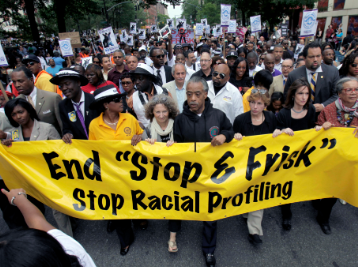
In a 2012 article titled, “Stop and Frisk: Racist and Ineffective,” CBS discusses how the program simply leaves the city with a “policy of racial harassment” since 2002. Although city officials stress that the program ensures safer streets, in reality, between 2002 and 2012 guns were found in less than 0.2% of stops (Miguel).
Rankine specifically mentions the Stop-and-Frisk program in New York City a few pages before when she writes, “Still you are not the guy and still you fit the description because there is only one guy who is always the guy fitting the description” (109). Although powerful alone, this quote aligns with the program. One may be able to feel sympathy for the “guy fitting the description,” but can only measure this pain intellectually, and empathize, by researching more. Readers would then discover that America’s most established city’s program allows police officers to temporarily detain, question, and search civilians on streets for weapons and contraband when they have “probable cause”. This new information adds another layer, and brings the reader closer to the perspective of the black man feeling targeted. As Richard William Paul and Linda Elder purport, the reader is now able to measure pain according to its depth, logicalness, accuracy, etc., giving them a lens that those without intellectual empathy cannot see.
In this example and other societal issues, intellectual empathy is crucial in deciding when pain is “worth” measuring. It’s impossible to accurately measure everyone’s pain on a universally used scale, a concept that Eula Biss sifts through in her work: “The Pain Scale”. Biss writes, “But pain presents a unique problem in terms of measurement and a unique cruelty in terms of suffering—it is entirely subjective” (12). Although measurement is challenging, some form of understanding the relativity of pain is necessary when analyzing society and where change should be focused. Rankine prioritizes the pain in the black community (rightfully so) in a unique manner by combining both the factual side of pain with the empathetic side.
In our modern age, the personal side of pain acts as the “cold side of the pillow,” as it gets lost in the abundance of news stories constantly flooding our screens. Our society has become somewhat immune to hearing news of tragedies, as we are used to hearing a new form of chaos every minute. This is no secret to the black community, as they face more hardships than many other target groups. Rankine flips the pillow over in her use of second person; subjectivity can no longer be a question when the reader is pressed with poignant anecdotes like, “It’s awful to go back home to find your own dead child” (Rankine 84). Suddenly, empathy is the only way to read into others’ lives.
Once the audience digests pain felt in Citizen, or any material discussing inequalities faced by target groups, it becomes a lot more difficult for the person to hang up their running shoes and call it a day. Social responsibility should kick in as motivation for humans to get our twisted society into shape. As Ross Snyder so simply states in his poem, “The Person Sitting Next to You”:
“She also has a right to be understood. And unless she can be understood by other people, she is thwarted from being a person” (1).
Empathy isn’t so simple, but the fact that we are all people is.
Why is it so hard for so many to understand?
Citizen challenges “you” to ask yourself that very question.
 Keeping Up With Caroline