Look at your reflection in the mirror.
What makes you matter? What makes up your matter?
According to a CBS News Survey, 97% of women have a negative body image.
Confidence in appearance ignites delicately for women and just as it begins to kindle, society reminds them of their lack of worth with another advertisement or discriminatory act, and the spark is snuffed. Roxane Gay explores what elements shape her in her memoir, Hunger, as she delves into her darkest vulnerabilities.
A quote provided by Roxane Gay’s website: reviews the complexities of her novel in relation to society.
The mashboard below reflects that your past, your present, and your future are all elements that shape self-perception.
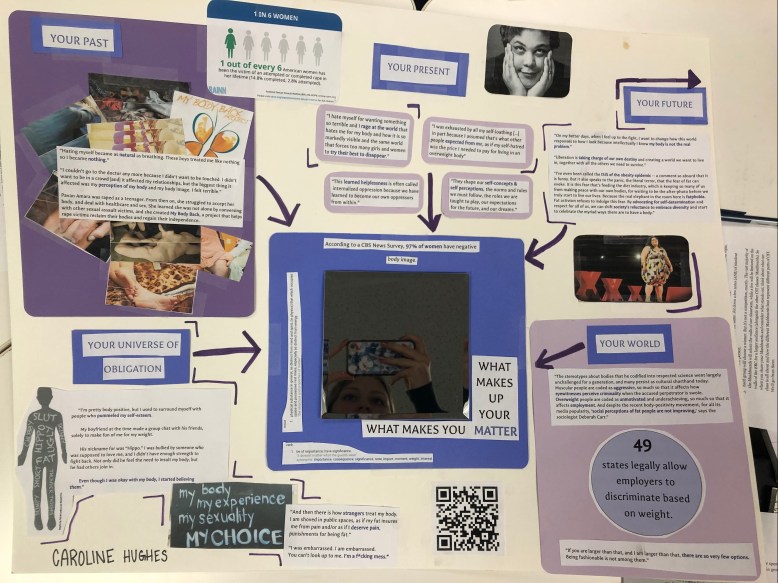
Photo courtesy of me.
What makes you / makes up your matter?
Your past.
Many are quick to judge others’ appearances without having an understanding of their background. Traumatic events often have a severe effect on self-perception and one’s relationship with his or her body. Rape victims specifically struggle with body-image issues, and not only in a sexual environment, as their self-image is clouded with shame.


Laura Bates, a journalist for The Guardian, quotes Pavan Amara, a rape victim: “The biggest thing it affected was my perception of my body and my body image. I felt terrible.” Rebuilding her courage, Amara created My Body Back, a project that helps rape victims reclaim their bodies. She sets a strong example for assault victims and bystanders alike; we are all components of the society that generates stigmas about body image. Gay expresses how people judge her yet few know she was raped at only age 12. She admits, “Hating myself became as natural as breathing. These boys treated me like nothing so I became nothing” (45). Rape further propelled her journey toward treating her body badly; Gay lost her independence and pride in her appearance the night of the crime. She felt broken, and now feels misunderstood and disrespected.
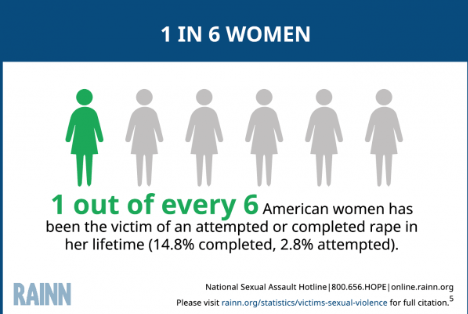
Statistic provided by Rape, Abuse and Incest National Network.
What makes you / makes up your matter?
Your present.
We critique nearly every aspect of our bodies. Although our conscience can alert us that this behavior is wrong and unhealthy, the devil on our shoulders that aligns with the oppressive power of the cycle of socialization consumes us as we fall into a self-defeating trap. Gay explains her frustration when she confesses her unconscious desires for anorexia, despite her conscious acknowledgment of the disorder’s destructive power. She reflects, “I hate myself for wanting something so terrible and I rage at the world that hates me for my body…and the same world that forces too many girls and women to try their best to disappear” (191). Gay raises the concern that too much our physical matter matters: those who take up less space in the world seem to be of more value.
A graphic in the Glenbrook North Torch about the powerful impact of labels formed from our environment on our personal body image. The article includes various stories anonymously submitted by students about their experiences facing the effects of the cycle of socialization here at GBN.

The cycle of socialization not only forms stereotypes, but also fogs our vision of the truth, propelling us further away from knowing our worth. The cycle’s hidden consequence is the detrimental effect these expectations have on self-treatment. Harro writes, “This learned helplessness is often called internalized oppression because we have learned to become our own oppressors from within” (50). People aren’t born disliking parts of themselves; we’ve bowed down to the cycle as loyal students, seemingly unable to question the doctrine.
What makes you / makes up your matter?
Your future.
Our future is a part of who we are; we spend much of the present planning what’s next. Those with body image issues, though, seem stuck and never search for self-love.
It’s a matter of putting forth the effort to stop setting appearance-altering goals, and to begin achieving self-love goals. As Harro explains, “Liberation is taking charge of our own destiny and creating a world we want to live in, together with all the others we need to survive” (624). By generating hatred of ourselves, we plant seeds for a society of misjudgment and preconception. Kelli Jean Drinkwater, an activist for body politics, defines her view in her TED Talk, “Enough With the Fear of Fat”: “I’ve even been called ‘the ISIS of the obesity epidemic…It also speaks to the panic, the literal terror, that the fear of fat can evoke…By advocating for self-determination and respect for all of us, we can shift society’s reluctance to embrace diversity and start to celebrate the myriad ways there are to have a body.” Liberation through advocacy develops throughout her speech, as Drinkwater serves as a model for a community of bystanders. If we all begin to see more of what our bodies are capable of and don’t fall prey to historical stereotypes, liberation becomes an attainable goal.
Our bodies—all bodies—can do incredible things. They enable us to build cities, to cure sicknesses, to embrace each other, to laugh. To love. To liberate not only ourselves, but also our society.
Look at your reflection in the mirror again.
Do you reflect the world you want to live in?
Sources in Mashboard:
- “Americans Can’t Escape Long-Disproven Body Stereotypes” – Amanda Mull – The Atlantic
- “49 States Legally Allow Employers to Discriminate Based on Weight” – Areva Martin – TIME
 Keeping Up With Caroline
I loved how you asked the questions at the end, it really forced me to consider everything you said and apply it to my own life.
LikeLike
Caroline – this is so good…I love how you tied everything together through the three main concepts of your past, your present, and your future. This blog is so well written and formatted. The questions you ask allow me to fully engage which I really appreciate.
LikeLike
I like the way you separated your blog post into three sections and repeating your clever phrase, “What makes up your matter/what makes you matter.” I can tell you spent a lot of time thinking about how to organize your mashboard and curating the most important quotes and research for and audience.
LikeLike
You did a really good job supplementing your ideas with visuals without distracting from your larger ideas. It helped your blog be incredibly concise and kept me engaged throughout.
LikeLike
I loved your mashboard! It was super creative and had a ton of great research.
LikeLike