Winter break lends itself to many activities and new adventures. It’s a perfect time to unwind, relax, and catch up with family while gathered around a fire. Or maybe it’s the right time to explore a new place, like the sunny beaches of Florida or the frosty slopes of Vail.
Although traveling is certainly a valuable privilege that shouldn’t be disparaged, over this break I learned a few key things. First, seeing the look on your great-grandmother’s face when she opens a handmade gift on Christmas morning that you sewed yourself is a euphoric feeling. Second, and far more related to CST, is that there is no need to travel to experience a new culture. Sometimes, all you need is a train ticket and set of walking directions to the Chicago Cultural Center, a gem in the middle of my home(ish) city.
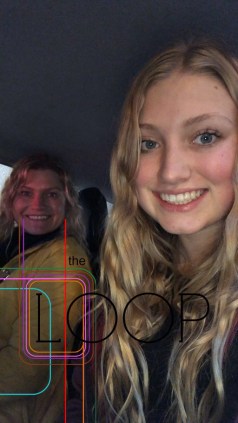
My mom and I in the cab entering The Loop on our way to the Chicago Cultural Center! Photo courtesy of me.
As my mom and I entered the building, I was awestruck with the incredibly detailed architecture with magnificent design. It felt fitting that the former Chicago library, so attractively constructed, now serves as the house for some standing cultural attractions plus a rotation of exhibits that have just as much value as the structure itself and the font of knowledge that preceded them. Value comes in many forms, and I gained perspective, self-revelations, and new understanding of the power of a word.


The Chicago Cultural Center itself aims to educate curious citizens who want to explore the societal components that make up our city–whether that be issues they can empathize with, or issues they had always, intentionally or subconsciously, turned a blind eye to. On my particular trip, I grasped insight to the African American culture, one I had always been eager to learn about but had yet to delve in to its layers.
As I reflect, I can’t help but clearly see that my fog of the African American culture is a result of my white privilege. If I had to deal with some of the issues later discussed in this blog that the African American community is forced to face, I would not be so lax when it comes to putting forth the effort to learn about this very prominent element of Chicago.
Peggy McIntosh explains this “fog” in her article, “White Privilege: Unpacking the Invisible Knapsack”, when she writes, “I could freely disparage, fear, neglect, or be oblivious to anything outside of the dominant cultural forms” (5) due to her race. Although the words “neglect”, “oblivious” and “disparage” all fit into the category of what many people in my sheltered hometown of Northbrook do with these target group issues, McIntosh’s word choice of “fear” stuck out to me. Connecting to my own life, I now understand that part of the reason I have failed to address discovering the contrasting cultures of the city (and beyond) is because I am fearful. I am fearful that I will not be able to empathize, understand, and do enough to aid in solving these issues, and I am fearful to finally acknowledge the ignorant position I have taken by hiding in the cushions of my privileges.
But fear is not excuse, and addressing reality is always the first step to making a change.
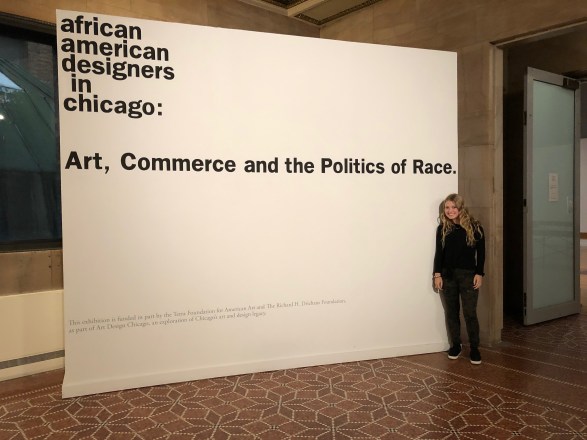
Outside the exhibit! Photo courtesy of my mom.
The first exhibit my mom and I ventured to was titled: “African American Designers in Chicago: Art, Commerce and the Politics of Race”. The bright room was packed with various media, propaganda, newspaper articles, advertisements, poems, and even children’s dolls that have represented the African American culture over the course of the 20th and 21st century. Although many of the featured pieces were historic, the explanations of the exhibits specifically highlight how these designs, made by African-American artists but still often in ways that seem to play into racist stereotypes, still impact media and are sometimes still present in media today.


Various examples of propaganda, advertisements and news articles in the exhibit. Photo courtesy of me.
What colors describe you? Does your mind immediate jump to the literal meaning of the word (black, white, etc.), or does it find a more creative answer: yellow on your happy days, blue to represent calamity, to name a few?
Or, through a different lens, what does the color of your skin mean to you? Is it the literal complexion number you may match up with your makeup, the heritage of your ancestors, or the stereotypes that define your social identity?
For those in the African American community, the word black means far more than any of the examples I listed. One of the striking pieces in the exhibit was a poem by Barbara D. Mahone, at Burrell McBain Inc., an advertising agency that specifically targets the African American community, written in 1969. Mahone artistically explains that the word black is far more than a skin tone; it is a representation of the bond her community, her family, has formed. She wrote, “The color of the blood we lose […] is Black,” emphasizing how the identity of the African American community has been strengthened throughout the turmoil they have faced.
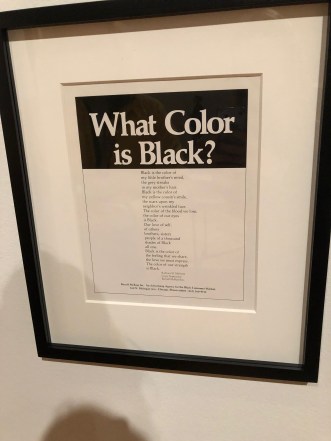
Photo courtesy of me.
While analyzing this poem and connecting it to contemporary issues today, it was strikingly clear how the ideas of Mahone parallel Gloria Naylor’s “A Question of Language” piece. Naylor, an experienced author, tackles the intimidating task of unpacking what the n-word truly means, how important context is, and who should be “allowed” to use it. Although my initial reaction to the n-word is always disgust because I have been taught that it is solely a racist term, Naylor explains how her family was able to take that apparent insult of a word and mold it to become an opportunity for community to strengthen. In discussing her family, she writes, “Gathering there together, they transformed n*gger to signify the varied and complex human beings they knew themselves to be. […] Meeting the word head-on, they proved it had absolutely nothing to do with the way they were determined to live their lives” (2). In the same way that Mahone transformed the word black to portray the strengths of her culture in the advertising industry, Naylor’s family made the choice to take the reins on their future, showing they are above the stereotypes and racist tendencies that still define our cycle of socialization.

Headshot of award winning novelist Gloria Naylor. Source: The Guardian
As I continued to explore the Chicago Cultural Center, I stumbled upon the exhibit featuring various stories, artwork pieces, poems, etc. of children who live in Chicago. It was titled Peacemakers and Community Connections. Although this exhibit and the first one I examined seem different at first glance, I could not help but draw similarities of the power of word choice. In the same way that both Naylor and Mahone taught their audiences that a word is far more than its basic definition, the artistic children exemplified this same idea when discussing what the term “Chicago” represents to them.
I stood in shock, noticing how nearly every piece dealt with violence and oppression in some manner. My heart was broken as I reflected on how I get the privilege of reminiscing on my childhood and remembering backyard barbeques, kick the can, and bike rides to the local ice cream shop, while these kids might look back on memories of gun violence, murders, and drugs, to name a few. My own rosy retrospection of my childhood is yet another white privilege I hadn’t acknowledged until my trip to this particular exhibit. Mary Schmich explains this concept in her article, “In a Word, a Slice of Perspective”. She demonstrates yet again the power of a single word, specifically referring to “portion”, describing how as we grow up, we attempt to equalize the servings of luck, love, and privilege we have personally received. She additionally, importantly, notes, “If we fully grow up, we also try to correct the inequalities of the servings given to others. We don’t have to look as far as China and Myanmar to notice how unevenly life distributes its bounty” (2). Living so close to the city, I only need to look 24.7 miles.
Twenty four point seven miles separates my sheltered childhood home from the destructive world of mass shootings, rapes, and starvation that builds the childhood “homes” of many Chicago-raised children.


According to the Chicago Sun Times, there were 588 homicides in 2018 in Chicago. Twenty four point seven miles, and 588 murders separate Chicago’s Brown Elementary school from my own Greenbriar Elementary School in Northbrook.
This saddening statistic allows for two thoughts to arise. First, how did I get lucky to land with this “portion” of privilege in my life? And second, it’s time to fully grow up, as Schmich says, and start giving to others.
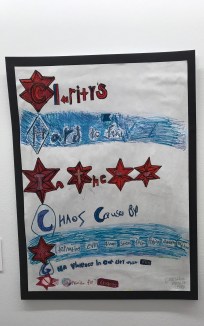
Elementary school student Celeste Ford’s acrostic poem, describing their opinion on what the word Chicago represents to them.
I am truly inspired by the strength these children had in expressing their raw, honest feelings of their living conditions that no human being should ever have to face. A poem by Celeste Ford from Brown Elementary School says that “Clarity is hard to find” with “Gun violence in our city, which kills the innocent and our optimism for change”. It’s difficult to find the words to describe the sinking feeling in my stomach, as I question why them, and not me?
As heartbreaking as these stories are, both the children featured in these exhibits as well as the adult authors and advertisers mentioned above are all entering Bobbie Harro’s Cycle of Liberation. She writes that to transform society, we need to be “creating anew a culture that reflects our coalition’s collective identity: new assumptions, new structures, new roles, and new rules consistent with a more socially just and equitable philosophy” (623). Liberation is about redefinition; understanding we are more than the words that once degraded us and decided the path we would be forging before we even took our first step.
My experience at the Chicago Cultural Center and connecting it to the impactful materials provided by CST has allowed me to take my first step, and not follow the ignorant, fearful path that was laid out by my privileges. I am redefining the word fear, and turning it into less of a red flag, and more of an optimistic challenge for change.
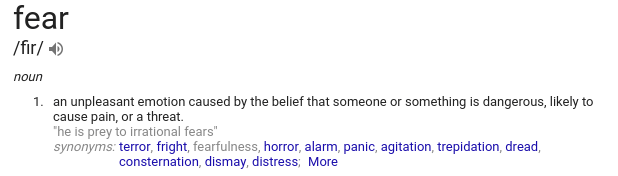
The literal definition of fear, that is although applicable in many situations, I will be working towards avoiding when it comes to social change. Source: Google
Throughout my maturation, sense of direction, and knowledge acquired through life experiences, by traveling both near and far, and through the Contemporary Social Themes coursework, I have abandoned my once cushioned position in my privileges. By visiting the Chicago Cultural Center and hearing all the children’s stories through their moving artwork and literature, I’ve realized how much I can grow by deciding to spend a few extra hours of my day pushing myself into a territory I have never traveled. I’ve realized that although fear of the intimidating, violent and depressing unknown is a tangible feeling, it should never stop me from exploration. The more I explore, the more I know, and the more I can help be the change.
Besides, life is better lived outside of your secure bubble. As American author Neale Donald Walsch says, “Life begins at the end of your comfort zone”.
 Keeping Up With Caroline