If I didn’t know any better, I might have thought I was going through a haunted house. What refugees have to endure is truly frightening, and like those October amusement attractions, Doctors Without Borders’ “Forced From Home” exhibit is startling, visceral, and, indeed, haunting. But it’s also real, and inspiring. By attending this exhibition, I gained new insight, and more importantly, began to empathize with immigrants as I took a few steps in their shoes through the simulation format of the event. Doctors Without Borders (DWB) labels itself not as a company or an organization, but a movement–a movement that aims to provide medical assistance in underdeveloped areas all over the globe, and to inspire others along the way. As its volunteers and experts trek a path of giving to others and helping those in need, DWB strives to gain as large a following as possible in not only asking for donations and volunteer help, but in also spreading factual, and often disturbing, information that is necessary for people to understand if they are to be active citizens. With this mission in mind, DWB set up an hour long tour/simulation that engaged us participants as we mimicked the steps refugees are forced to take as they embark on their struggle being forced from home. As we followed the track, we heard powerful statistics, personal stories, and medical insight; and absorbed impactful pictures. Megan Philbin, Sami Scholl and I were guided by DWB workers who had personally given aid in multiple countries in need, including Greece. Although it is impossible to ever fully know what a refugee experiences without being in their position, this immersive tour brought my perception more parallel to reality, as I gained a new perspective on what it is like to not be treated with basic human dignity.
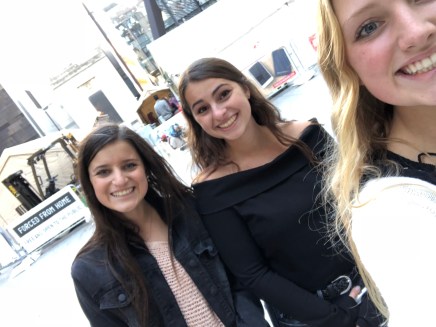
Megan Philbin, Sami Scholl, and I prior to entering the tour. Note: these expressions do not reflect our emotions during the tour, we were just excited to be there! Photo courtesy of me.
The simulation began with a 360-degree video dome that played clips from underdeveloped countries, interviews of refugees as well as DWB professionals, and videos of the journey to a new land (most commonly the United States or a country in Europe). The video set the stage for the entire afternoon, as the 360-degree aspect immediately gave off the effect of immersion. I was taken aback by how difficult it was for some of the refugees to explain their situation; they were often brought to tears as they described the need to take the risk of evacuating their home, all they’ve ever know, in order to provide a better opportunity for their children. I almost has tears in my eyes, as I reflected on how I never had to even think twice about where I live, my protective shelter, while other children in impoverished or war-torn areas are having their whole world flipped upside down to a strange new place far, far away.
I do not have to think about my location of living because I do not live in an area in which my safety, health, and security is always on the line.
I do have to think about how moving to new environments in the future will affect me, as I have been privileged to rarely have to worry about my safety.
The dome stage is what initially sparked me to think about I do/do not statements, and through following the journey of a refugee, I was subconsciously always comparing their circumstances to my own. This comparison was also fueled by the guide’s constant provocative questioning that allowed for an interactive and thoughtful environment, like when our guide asked, “Have any of you ever had to see a loved one pass? How about your own child passing?” These questions clearly hit home with many of the participants, and made me feel a thousand times more thankful that I am able to take a breath when it comes to worrying about the safety of my family. However, being thankful is not enough. I started entering the mindset that I need to help, too.
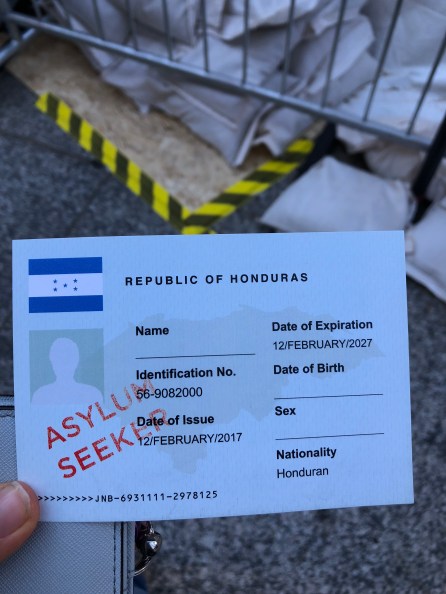
The identification card assigned to me. Photo courtesy of me.
The next stage was labeled “push factors,” and we learned about the reasons a refugee would be forced to flee their native land, including lack of resources, a corrupt government, war/violence, ethnic and religious tension, health care access, natural disasters, economic instability, etc. I was given an “identification card” that said I was an asylum seeker from the Republic of Honduras. I learned about other countries too, like the fact that 4.4 million Sudanese people have been forcibly displaced due to attacks, violent conflicts, health care instability, and diseases like malaria. In order for this stage to cultivate participants, the program directed us to take only 30 seconds to pick five items we could take from home on the long journey ahead. The pool of options included everything ranging from wheelchairs to passports to fishing gear. I decided to take my passport, my pets, my phone, whatever money I had left, and pictures of my family. This quick decision proved to be difficult, and I struggled to decide if I had made the right choice, as taking pets may be impractical even though they are considered family to me. Throughout the simulation, we were forced to give up our objects one by one until we had nothing left. This became increasingly difficult for me, and I thought back to those I do/do not statements.
I do not have to live in fear of what vital item I may have to sacrifice on a regular basis because I live in a financially stable area with people I know protect me.
My ability to empathize began to grow in this stage, as I struggled internally while choosing what to give up. I couldn’t imagine how difficult those decisions would be in real life.
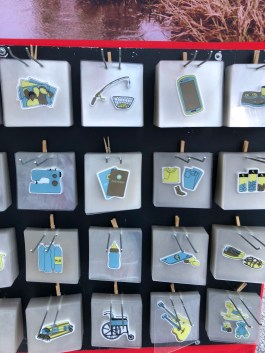
Examples of the item cards we had to choose from when deciding what to keep and what to sacrifice as a refugee. Photo courtesy of me.
The next two stages taught me about transportation and legal status. The guide explained to our tour group that unregulated transportation can be extremely dangerous and how so many refugees are lost or killed taking this transportation. Examples may include overcrowded lifeboats, riding the tops of trains, or trekking on foot for seemingly endless miles. Surviving the slog, however, could prove fruitless if the legal status of a forcibly displaced person was not accepted at their destination. The legal statuses listed included: internally displaced person, asylum seeker, refugee, stateless person, and migrant. For me, learning the differences and the recognizing some of the intricate nuances across the labels is crucial to becoming an active, well-informed, and empathetic citizen. This is exactly what we strive to do in CST. In order for me to take on my goal role as an ethical human being who avoids egocentrism and biased opinions, I need to understand the difference between these categories. For example, I was not aware of what an asylum seeker is, because I had been socialized through the cycle to immediately link the work “asylum” to the words “mentally insane,” and that’s all I ever grew up hearing. However, now when I do a Google search on the definition of asylum, the mentally ill example is marked as “DATED.”
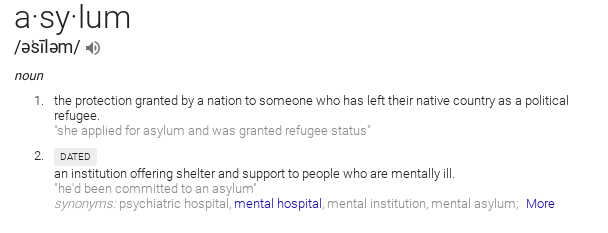
My oblivion of what this word really means showed how much I had to learn through the simulation, and I now understand that seeking asylum really means seeking protection. I was drawn back into CST, as I know I am constantly learning from my peers by observing what terminology is correct and what is considered unacceptable and/or hurtful in today’s society. Understanding terminology, what labels indicate, and what stereotypes come with these labels are all critical in the process of becoming an active citizen.
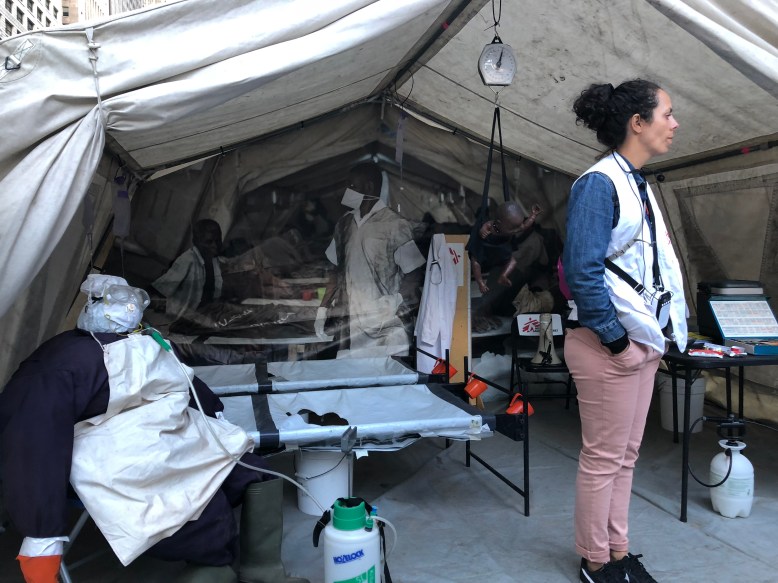
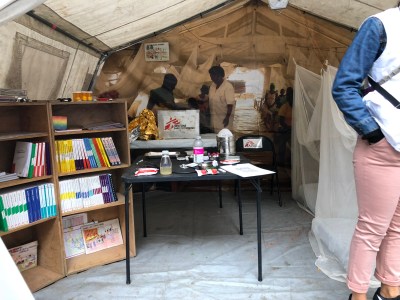
- Examples of mock medical tents/basic needs centers. Photo courtesy of me.
Next on our mock journey came the stations of basic needs and medical needs. At the basic needs station, the tour guides told us that DWB provides camps that the refugees reach as they cross various borders. DWB aims to provide food, clothing, connectivity, water, hygiene, waste management and shelter, although they are not always able to accommodate all due to limited funding. This station was particularly intriguing because of the visual comparison shown below. A person needs 2 gallons of water a day to survive, including that used for drinking, waste, washing, etc. However, the average American uses 90 gallons each day. I was taken aback and now reflect on my egocentric tendencies, how I have hardly ever taken time to analyze where I can save water and how I can give opportunities for water to those in needs. In this situation, I am acting as the good-hearted, but uncritical person. As Elder and Paul explain in The Thinker’s Guide to Ethical Reasoning, the uncritical person is “manipulated by self-serving critical persons and easily indoctrinated” which results in “the person being victimized or blindly led into victimizing others” (8). Prior to the simulation, I was in an oblivious state, and only feeding to the cycle by taking actions that unintentionally hurt others (not saving water) instead of helping others, which Elder and Paul emphasize as the basis of being ethical (4). The medical stations had the same effect on me, as I realized how many basic needs I take advantage of, like my nearly unlimited supply of nutrient-dense food (while most refugee kids are malnourished) or my access to clean needles and nurse assistance. The guides explained to us that the most common medical concerns of displaced people include unsafe water, insufficient food, poor hygiene, overcrowding, exposure to elements, and little access to medical care.
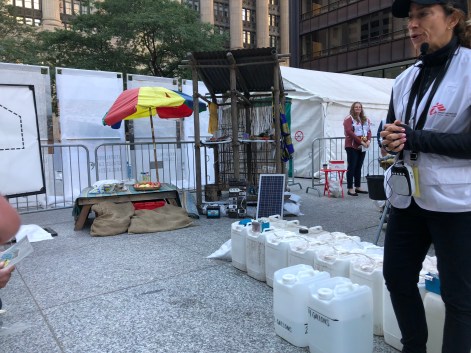
The visual provided to show that the average person needs 2 gallons of water per day to survive, and how each American uses 90 gallons daily. Photo Courtesy of me.
Once we finally reached our camping and destination stages, I was in awe of how many factors are in play when a person flees his or her country, either intentionally or unintentionally. The guides were able to express the refugee crisis concern of DWB through using facts and figures versus opinions and political motives, which is essential in proving their points and gaining a wide following. To close the tour, the guides provided us with an impactful quote: “At a time when global displacement is at record highs, many of the world’s richest countries–including the U.S–are closing their borders or sending people back to places where they face death and persecution” (Jason Cone, DWB USA Executive Director). They followed up this quote by emphasizing that seeking safety is not a crime.
Because deciding where and how the refugees will experience their journey is a controversial topic that deals with a variety of ethical issues, it is essential that the DWB projects must follow the guidelines of the ethical reasoning handbook. If the organization did not act under a neutral political stance, people of the opposing opinions would be quick to shut it down and dismiss the organization as manipulating. Elder and Paul write, “Ethical concepts are hopelessly confused with theological, ideological, and legal ones. This confusion often keeps people from doing what is ethically right” (36). By attending this event, I learned how presenting a controversial topic without pseudo-ethics is possible and necessary for the progression of our world. This simulation clearly heavily relates to our CST class, because being an active citizen includes staying updated on current events, being able to reflect on our own privileges (I do/do not statements), and learning how to use ethical reasoning before making decisions, and potentially changing lives for the better.
Seeking safety is not a crime.
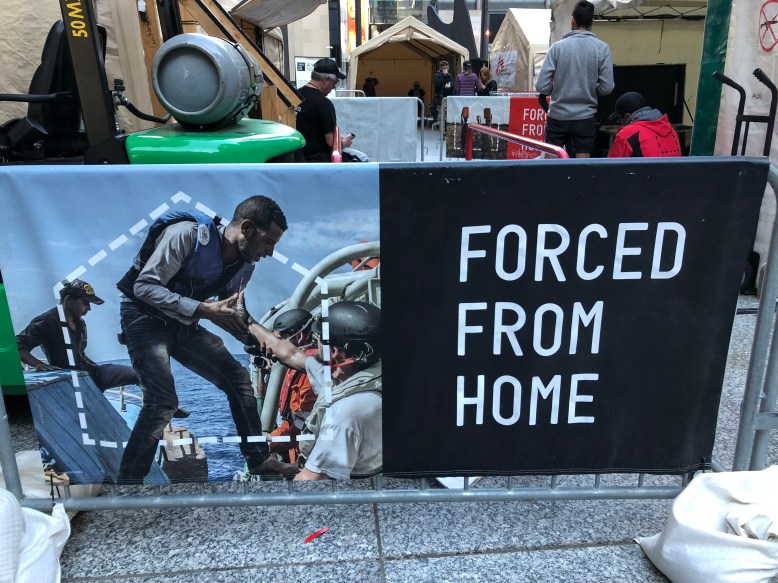
Photo courtesy of me.
 Keeping Up With Caroline